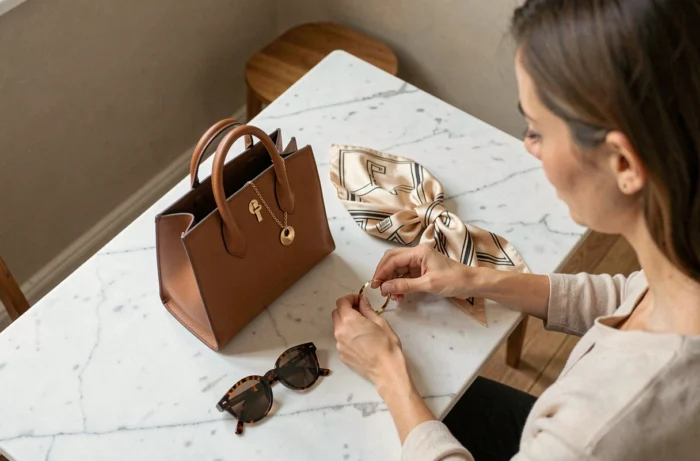
A fashion accessory refers to any item added to an outfit to alter its visual perception: jewelry, bags, belts, scarves, hats. Its function goes beyond mere decoration. Each piece affects proportions, color contrasts, and the overall reading of a silhouette. Understanding this mechanism allows for more precise choices, without accumulating unnecessary pieces.
Proportions and Volumes: The Structural Role of Accessories on a Silhouette
The size of an accessory directly alters the perception of body proportions. A bag worn at the hip draws attention to that area and visually widens it. Worn with a short crossbody strap, it raises the focal point toward the bust.
The fall-winter 2026-2027 collections emphasize this logic: according to Vogue Türkiye, the runway shows favor large and highly visible accessories, whether they are statement jewelry, wider bags, or belts with large buckles. This choice of bold volumes is not trivial. A statement necklace on a round collar creates a framing effect around the face, while a wide belt defines the waist and segments the silhouette into two distinct blocks.
To take advantage of these effects, one must think in terms of contrast. A large accessory works best with an outfit featuring clean lines. Conversely, an already structured outfit (defined shoulders, wide patterns) benefits from keeping accessories understated. Those browsing the accessory selection at Cœur 2 Mode will find this contrast logic applied to various categories of pieces.

Scarves and Brooches: Multifunctional Accessories in 2026
The scarf has changed its status. It is no longer worn solely around the neck. Analyses from Vogue published in September 2026 document its use in hair, around the waist, or tied to a bag handle. This versatility makes it an accessory with multiple lives in the same wardrobe.
The choice of material matters. Opaque textures are gaining ground against classic silk, allowing scarves to be worn with autumn outfits without creating a mismatch. A mixed wool scarf tied at the waist over straight pants creates a soft belt effect, less rigid than a leather belt.
The Return of Brooches and Charm Jewelry
Brooches and charm necklaces are not merely a nostalgic effect. Vogue describes these pieces, in its article from September 4, 2026, as tools for personalizing an existing garment. Pinning a brooch on a blazer lapel or on a bag strap alters the piece without needing to purchase a new one.
The charms added to a necklace or bracelet operate under the same logic. Each addition changes the visual outcome, extending the perceived lifespan of the jewelry. This modular approach suits individuals who want to vary their style without multiplying purchases.
Building a Cohesive Accessory Game: Concrete Selection Criteria
Accumulating accessories without logic creates a cluttered effect. Cohesion relies on three identifiable criteria.
- The Material Register: Mixing shiny gold metal with raw matte leather creates a desired contrast. Mixing plastic with silk creates a perceived mismatch. Each material sends a signal of register (casual, dressed, technical), and these signals must remain compatible.
- The Color Palette: A maximum of three color families between accessories and the outfit avoids visual dispersion. A tawny bag, gold earrings, and a cream scarf remain within a unified warm register.
- The Number of Pieces Worn Simultaneously: Beyond three visible accessories, the viewer’s gaze no longer knows where to settle. Even in a trend favoring bold volumes, visual hierarchy takes precedence over quantity.

European Regulation and Accessories: What Has Changed Since July 2026
Since July 19, 2026, a European regulatory evolution directly affects clothing accessories. Large companies can no longer destroy certain unsold items, except for exceptions provided by the regulation. They must also publish information on the volumes of unsold items destroyed and the reasons for this destruction.
This constraint has a concrete effect on the available supply. Brands adjust their production volumes and favor pieces with a longer turnover. For buyers, this means that accessory collections are tending towards more durable pieces, designed to remain relevant beyond a single season.
The digital passport for textile products, currently being rolled out at the European level, should ultimately allow for complete traceability of an accessory (materials, place of manufacture, environmental footprint). This transparency will help distinguish pieces produced under verifiable conditions from those that are not.
A Quality Criterion Now Verifiable
The quality of an accessory is no longer limited to the tactile impression in-store. Transparency obligations are gradually making manufacturing information accessible. Choosing an accessory with documented composition and origin becomes a selection criterion on par with color or shape.
Thus, the choice of an accessory is based on a cross-section of the desired visual effect, compatibility with the existing wardrobe, and verifiability of its manufacturing. The trends of 2026 confirm that modular personalization (brooches, charms, repositionable scarves) offers more latitude than an impulsive purchase of fixed pieces.