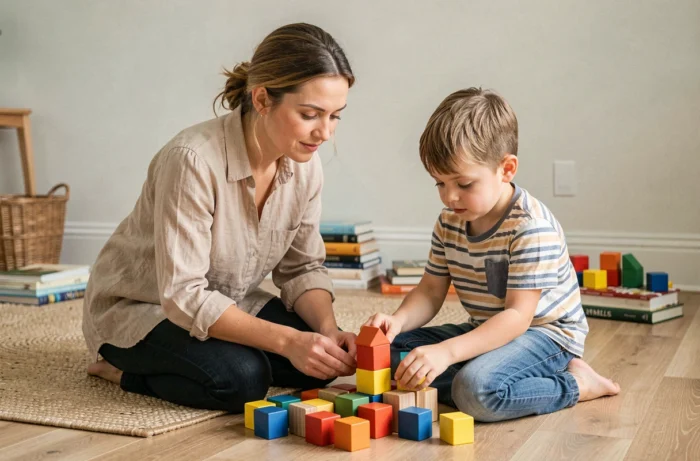
A child who refuses to dress alone in the morning, another who bursts into tears over a failed puzzle: daily growth happens in these micro-situations, not in grand educational principles. Supporting a child’s development starts with observing what gets stuck in the routine and adjusting the environment around them.
Parental control and screens: the regulatory framework that changes the game
Since July 13, 2024, connected devices sold in France must include free parental control, which can be activated from the first setup. This system allows for limiting access to certain content and blocking the download of apps prohibited for minors.
In practice, there is no longer a need to install a third-party app or dig into advanced settings. The control is offered at startup, making it easier for parents who are less comfortable with technology.
The High Council of Public Health recommends no screen time before age 3 when usage is not accompanied by an adult, no screens in the bedroom, and a shutdown at least one hour before bedtime. After age 3, four criteria matter: age, content, supervision, and what the screen replaces (sleep, movement, play, or interaction).
Additionally, many online resources help structure daily life around children on mamanserepose.fr, with age-appropriate approaches.
The inter-ministerial report submitted in April 2024, titled Children and Screens: In Search of Lost Time, recommends delaying access to connected smartphones for young children. This is not a legal obligation, but the political signal is clear: we are moving from a universal time threshold to a context-based logic.

Screen-free activities: replacing passive time with concrete experiences
Cutting screens is not enough if nothing is offered in return. The real lever is having readily available activities that are engaging without complex preparation.
Prioritize sensory and physical experiences
A child aged 3 to 6 learns just as much by kneading playdough as by following an educational program on a tablet. The difference: the sensory feedback is immediate, and mistakes do not generate digital frustration (no “game over”).
Free movement remains the primary driver of development at this age. Climbing, jumping, and running in a park or garden engage coordination, risk management, and self-confidence, three areas that sedentary activities do not cover.
Music as a daily learning tool
Singing a nursery rhyme on repeat is not trivial. Music works on memory, rhythm, and vocabulary simultaneously. Musical moments can be integrated into daily transitions: a song for brushing teeth, another for tidying up.
Feedback varies on this point depending on the children, but the regularity of the musical ritual seems more effective than the duration of the activity itself.
Supporting emotions: concrete tools for parents
In the face of a tantrum, the temptation is to minimize (“it’s nothing”) or to immediately redirect (“stop crying”). Both approaches cut off the child’s emotional process before they can identify what they are feeling.
Naming the emotion out loud helps the child recognize it. “You are angry because your tower fell down” gives a verbal framework to a still vague sensation. This is not complex psychology; it is a habit to establish in daily life.
- Use a visual “emotion thermometer” (displayed in the kitchen or bedroom) so the child can point to their state without needing words.
- Offer a physical release gesture: squeezing a cushion, stomping feet on the ground, blowing hard into their hands. The body releases faster than language at this age.
- Reflect on the episode after calming down, rephrasing what happened. This step transforms the crisis into a learning experience.
The goal is not to eliminate tantrums (they are part of development), but to shorten the time between the outburst and the return to calm.
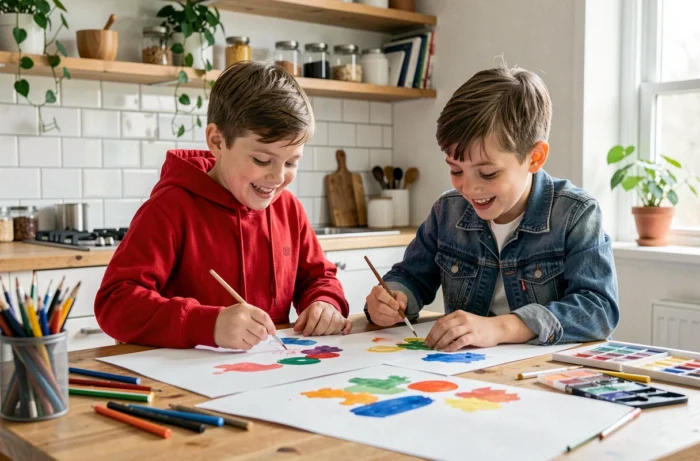
Self-confidence in children: valuing the process rather than the result
A systematic “well done, it’s beautiful!” eventually loses its value. The child no longer knows if they are being praised reflexively or sincerely. Describing what we see has a more lasting effect on confidence.
“You chose blue and green, and you filled the whole page” is a factual observation. It shows the child that we have looked at their work without value judgment. Precise description advantageously replaces automatic compliments.
- Comment on effort rather than talent: “You tried three times, that’s perseverance” instead of “You are talented.”
- Let the child evaluate themselves: “What do you think?” before giving an opinion.
- Accept an imperfect result without correcting. A figure with three arms is a normal stage of graphic development.
Independence is also built through small responsibilities: setting the table, choosing their clothes, pouring water into their glass. Each task completed without adult intervention reinforces the sense of competence.
Family environment and rhythm of life: what truly structures the day
Predictable routines provide more security than reassuring words. A child who knows that bath time comes after dinner and story time before lights out expends less energy anticipating what comes next.
A visual schedule with pictograms can be displayed for children who cannot read yet. This simple tool reduces repetitive negotiations (“what are we doing now?”) and gives the child a reference point they can consult independently.
The sleep rhythm remains the foundation for everything else. A child who is sleep-deprived manages their emotions less well, concentrates less, and enters into conflict more easily. Protecting bedtime, including on weekends, has a direct impact on the quality of family daily life.