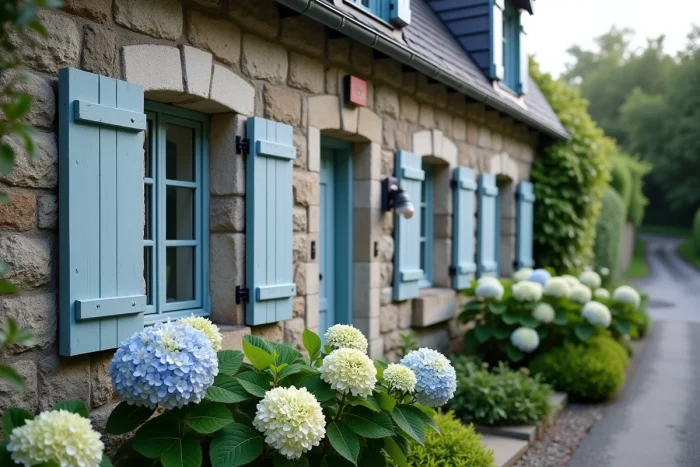
The color of a window in Brittany is not chosen from a color chart without first checking what the local PLUi allows. The PLUi of Brest metropolis, for example, explicitly prohibits fluorescent or shiny metallic joinery and requires shades that harmonize with granite, slate, and light coatings. Ignoring this constraint before placing an order risks a refusal of compliance after installation.
Regulatory constraints and ABF: what the RAL color chart does not say
The Architects of Buildings of France in Brittany have evolved their doctrine. Where dark shades were almost systematically refused, Brittany’s ABF now accept deep but matte shades: anthracite gray, midnight blue, dark green. The condition is clear: no reflections on the landscape or the coastline.
We recommend consulting your municipality’s urban planning department before any color validation. Each sector of the PLUi may have its own restrictions, even within the same intercommunal area. A matte RAL 7016 anthracite gray is acceptable in a recent housing development in Quimper, but will be refused near a classified monument if the finish is satin.
To choose the right color for your windows in Brittany, you must therefore cross three filters: the local urban planning regulations, the ABF opinion if the area is protected, and the palette offered by the manufacturer in the required finish.
Bicolored windows in the Breton climate: balancing facade and interior

Brittany manufacturers like Atlantem or Bouvet report a significant increase in orders for bicolored windows. The dominant scheme: dark gray or dark green outside, white or light wood inside. This choice meets a dual objective: to respect the facade charter imposed by the municipality while maintaining a bright atmosphere inside, in a region where sunlight remains moderate for a good part of the year.
Bicolorization is not just aesthetic. On an aluminum profile, it involves two distinct coatings (or an interior lamination), which affects the price and manufacturing time. For PVC, the wood-effect laminate on the interior combined with a solid color or tinted film on the exterior remains the most common combination.
Points of caution regarding bicolorization
- Ensure that the manufacturer guarantees the durability of the exterior film or coating against UV and sea spray. A Qualicoat Seaside label on aluminum is a minimum in the Breton coastal area.
- On the interior side, a light wood veneer withstands ambient humidity well if the housing ventilation is adequate, but it yellows faster than a RAL white in a poorly ventilated room.
- Always request a physical sample: colors on screen do not accurately represent the matte or satin finish, which is crucial for acceptance by the ABF.
Durability of dark colors against saline wind and Breton humidity
Choosing an anthracite or midnight blue window in Brittany raises a technical question that consumer articles often overlook. Very dark colors on houses exposed to saline wind significantly increase maintenance needs. Salt deposits create white marks that are much more visible on a dark profile than on a light frame.
The material determines the frequency of cleaning. Lacquered aluminum with a Qualicoat treatment can be cleaned with clear water once or twice a year in coastal areas. Mass-tinted PVC withstands the chemical aggressions of salt well, but its slightly porous surface retains more micro-dirt.
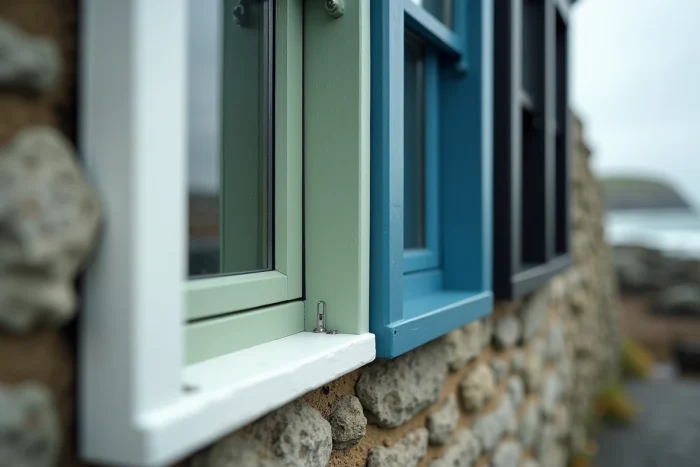
Aluminum, PVC, or wood: which material for which shade
Aluminum offers the widest palette via the RAL color chart. We observe that Breton carpenters commonly offer between 200 and 400 shades, with a varying surcharge depending on whether the color is standard or custom. PVC has caught up somewhat thanks to laminated films, but the available shades remain fewer.
Painted wood theoretically allows for any color, but the need for repainting every few years is a maintenance item to factor into the budget, especially on west-facing facades exposed to prevailing rains. An exotic wood (such as moabi or red cedar) with a tinted stain reduces the frequency of repainting, without eliminating it.
- Lacquered aluminum: nearly unlimited palette, low maintenance, moderate surcharge on standard shades.
- Laminated PVC: good chemical resistance to salt, expanding palette, caution on the fading of dark films exposed full south.
- Painted or stained wood: complete freedom of color, regular maintenance non-negotiable in an oceanic climate.
Window color and coherence with slate roofing and shutters
In Brittany, gray-blue slate roofing dominates the built landscape. This factor strongly influences the chromatic choice of joinery. A pure white (RAL 9016) creates a sharp contrast that works on stone or light-coated houses. A medium gray (RAL 7035 or 7040) integrates more discreetly on granite facades.
A common mistake is to choose the window color independently of the shutter color. When both elements are simultaneously visible on the facade, a color temperature gap (a cold blue-gray shutter with a warm gray-green window, for example) produces an inconsistent result that the PLUi does not always penalize, but which degrades the architectural reading of the building.
We recommend placing the joinery, shutter, and a fragment of facade material samples side by side, in natural outdoor light. Showrooms lit with artificial light distort perception, especially for gray and green shades that shift according to the lighting temperature.
The final choice depends as much on local regulations as on the material’s ability to age gracefully under the Breton climate. Taking the time to validate the shade on-site, with a physical sample placed against the facade on a cloudy day (the dominant light in Brittany), remains the most reliable method to avoid unpleasant surprises after installation.