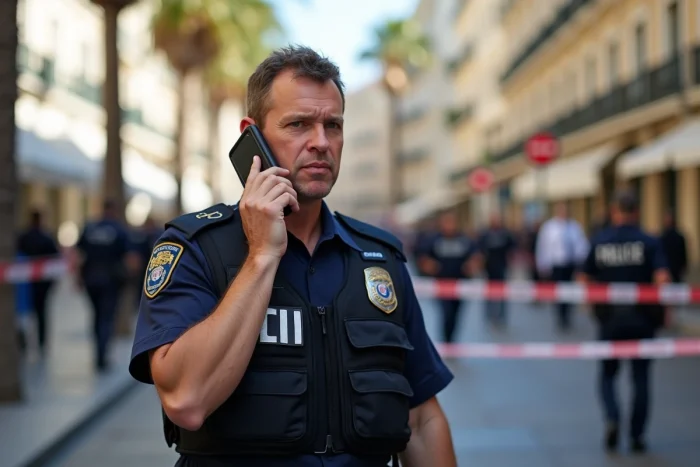
A simple alert message, and an entire city comes to a standstill. This morning in Cannes, the announcement of a threat was enough to disrupt the ordinary rhythm: barriers erected, sirens in the background, law enforcement at every street corner. The prefecture and the town hall, united in urgency, implemented the instructions without hesitation. Several sites became inaccessible, residents were asked to move away, and businesses suddenly froze in anticipation. Nothing was left to chance: every gesture, every decision, follows a meticulous protocol, already tested during previous alerts.
What we know about the bomb threat in Cannes: facts, affected locations, and initial elements
This morning, as the city was just waking up under the spotlight of the festival, one word chilled the atmosphere: bomb threat. The Palais des Festivals, the beating heart of the event, found itself surrounded by a security cordon. A suspicious package spotted nearby immediately triggered the well-oiled machinery of the evacuation plan. National police, municipal forces, bomb disposal units: everyone was on deck to secure the area, while passersby, invited to leave the premises, observed the scene from a distance.
The targeted sites are far from trivial. The Palais, a symbol of the city, and several strategic axes of the center were targeted, forcing the immediate activation of crisis management measures. Sirens, messages broadcast in a loop, repeated instructions: information circulated quickly, avoiding panic while imposing caution. Specialized agents combed the area, inspecting every nook and cranny, while shopkeepers watched, shutters down, the uninterrupted ballet of uniforms.
The authorities, contacted in urgency, have not found any explosive devices so far. The investigation continues, and uncertainty looms. For those wishing to follow the situation hour by hour or consult confirmed elements, information on the bomb threat in Cannes today remains the source to watch. This mobilization, which today extends across all of Provence and beyond, has now become part of daily life: each new alert triggers the same tight management, the same collective mobilization.
How are the prefecture and town hall reacting to the threat today?
No room for improvisation: the Alpes-Maritimes prefecture and the town hall of Cannes activate the crisis cell within minutes. The priority: ensure safety, organize the deployment of personnel, and communicate instructions without delay. Every agent knows where to position themselves, every protocol is applied in the wake. The situation demands precise coordination, balancing the rigor of the intervention plan with adaptation to the reality on the ground.
In the streets, police presence intensifies around the Palais des Festivals. The firefighters remain on alert, ready to intervene at the slightest incident. The FR-Alert system notifies those concerned in real-time, while loudspeakers and sirens relentlessly remind people of the instructions to follow. Crisis management officials also monitor social media to contain the spread of false information that could disrupt operations.
Measures implemented:
Here are the concrete actions taken on the ground to respond to the situation:
- Rapid evacuation of the targeted areas and securing the immediate surroundings
- Provision of an emergency number to reassure and inform residents
- Deployment of psychological support for those affected by the situation
- Continuous and updated information through FR-Alert
The town hall emphasizes the distinction between verified facts and rumors, a point reiterated at every statement. Communication aims to be transparent, but without succumbing to the spectacle of false alerts. This rigor takes on full significance as major events approach, where the collective management of uncertainty becomes a challenge for all.

What are the consequences for residents, businesses, and local life after the alert?
The shockwave of this bomb threat has spread far beyond the Palais des Festivals. In Cannes, daily life has been disrupted: deserted streets, businesses hastily closed, conversations suspended in queues or building lobbies. Parents, alerted by notification, rushed to pick up their children from school. Teachers, in turn, had to show pedagogy and composure to reassure students, sometimes gripped by anxiety.
In businesses, the day leaves a bitter taste. The loss of earnings adds to the worry: tourism professionals, already weakened, fear that such incidents may recur as the Olympic Games or other major events approach. Restaurateurs, booksellers, hoteliers share a common fear: seeing attendance dwindle, trust erode, and the public become wary of gathering places.
Public health also becomes an issue. A helpline has been set up, while local associations mobilize to support the youngest and the vulnerable. An anxious climate settles in, relayed by phones saturated with messages and alerts. Even once the threat has passed, vigilance remains essential, and daily life in Cannes bears the mark of this unusual day.
The threat has dissipated, but the memory of the alert continues to resonate. In Cannes, as elsewhere, every siren reminds us of the fragility of daily life, and the ability of a city to reinvent itself in the face of the unexpected.