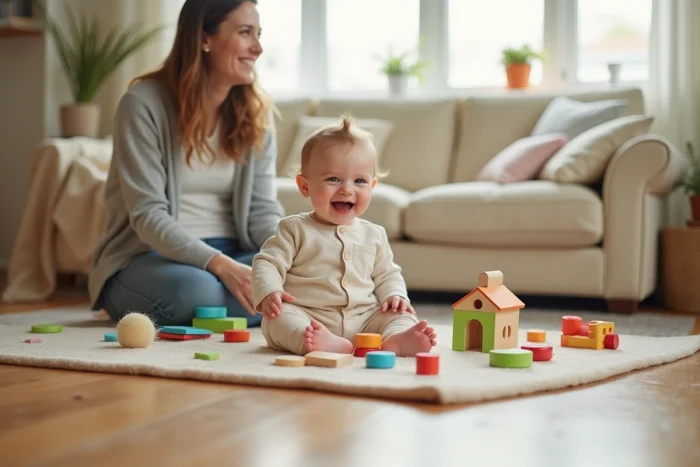
At 8 months, a baby begins to grasp objects with precision, to understand that what disappears still exists, and to react to sounds with intention. However, their attention span remains short, and overstimulation can quickly tire them out. Age-appropriate activities take these limitations into account: they are brief, repeatable, and engage one or two senses at a time.
1. Basket of everyday objects for free exploration
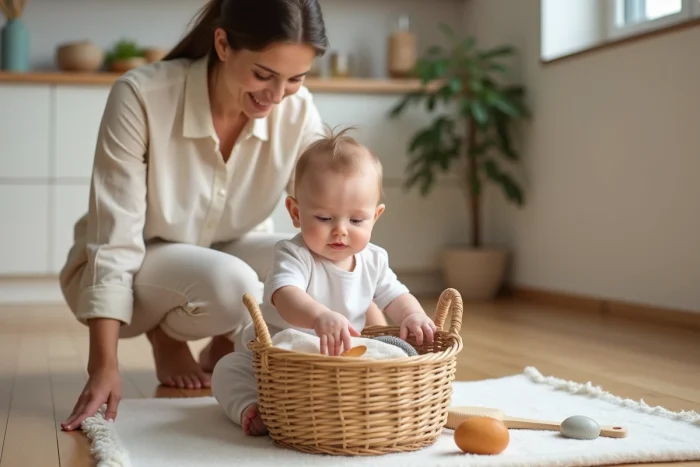
Rather than a single toy, a basket containing a few safe household items (wooden spoon, clean sponge, small whisk, stainless steel cup) offers a tactile variety without overstimulation. The baby chooses, touches, brings to their mouth, and puts down. This approach, similar to the treasure basket described in Montessori pedagogy, respects their exploration rhythm.
To learn more, baby activities on Imazine also detail this type of free play suitable for toddlers.
Limit the basket to a maximum of five objects. Too many choices can tire a baby of this age. Rotate one or two objects each week to maintain curiosity without creating overload.
2. Peek-a-boo game with a light cloth

Pek-a-boo is not just a fun classic: it works on object permanence, a major cognitive milestone around 8 months. The baby begins to understand that the parent’s face still exists, even when hidden.
A simple scarf is enough. Place it on your head, wait a second, then remove it. Repetition reassures and reinforces understanding. You can also hide a small toy under the cloth and let the baby find it.
3. Transferring with large dry pasta
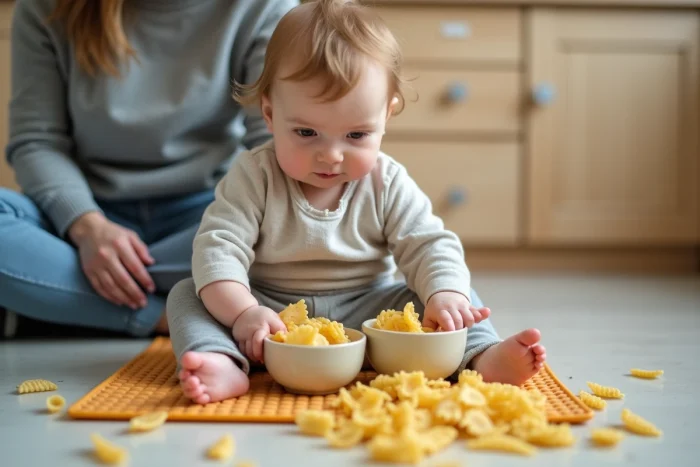
Two bowls and a handful of large raw pasta make for an accessible hand-eye coordination activity starting at 8 months. The baby tries to transfer the pasta from one container to another, first with their hands, then possibly with a wide spoon.
Choose large pasta (rigatoni, conchiglioni) to avoid any risk of ingestion. Supervision is necessary, as at this age, everything ends up in the mouth. Place everything on a tray to contain any spills.
4. Textured board book for interactive reading

Reading at 8 months does not resemble a story told from beginning to end. A photo book or a textured book works better: the baby turns the thick pages, touches the rough or soft surfaces, and gradually associates images with simple words you name.
This type of early interactive reading stimulates language long before the baby can speak. Name what they point to, repeat the words, let them go back. Two or three minutes are enough before they lose interest.
5. Water play in a shallow basin
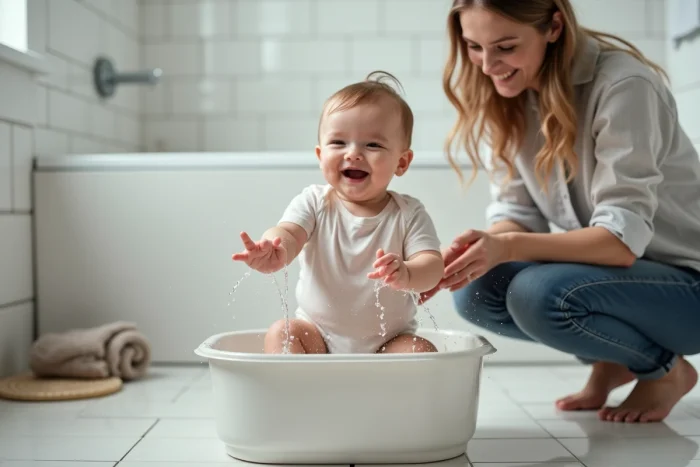
A basin with a few centimeters of warm water, two cups, and a small strainer: the activity engages touch, sight, and understanding of volumes. The baby pours, splashes, and observes the water flowing through the holes.
Water also has a regulating effect on an emotional level. For a fussy baby or at the end of the day, a few minutes of water play can help regain calm. However, supervision must be constant, even with very little water.
6. Nursery rhymes with repetitive gestures

Nursery rhymes like “Ainsi font font font” or “Les petites marionnettes” combine rhythm, melody, and movement. At 8 months, the baby does not yet replicate the gestures, but they anticipate them after a few repetitions. This anticipation is a sign of cognitive awakening.
Three nursery rhymes in rotation are sufficient. Repetition is not a lack of creativity: it allows the baby to memorize the sequence and begin to participate with their hands.
7. Tower of blocks to knock over
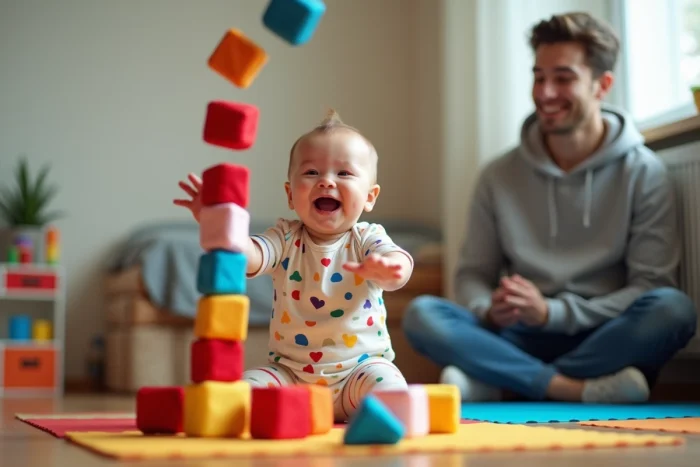
At this age, building a tower exceeds their motor skills. However, knocking over a stack of blocks is a perfectly suitable cause-and-effect game. You stack three or four lightweight blocks, and the baby knocks them down with a hand gesture. The noise, the movement, the disappearance of the structure: it all captivates them.
This game develops the understanding of causal relationships. The baby learns that an action on their part produces a visible and reproducible result.
8. Crawling on different surfaces
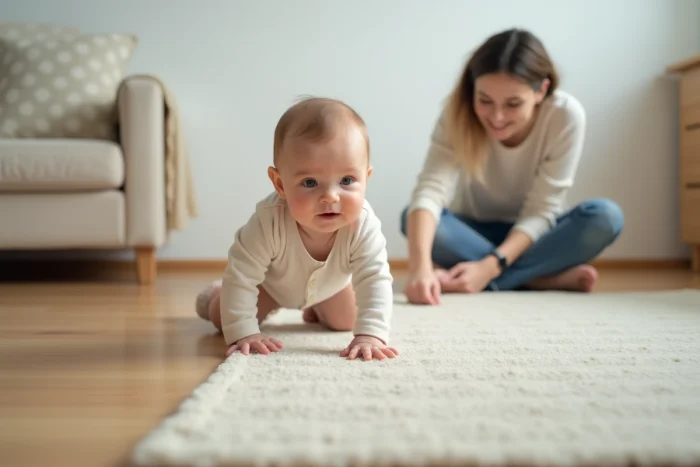
If the baby is starting to crawl or move on all fours, varying the surfaces on the floor enriches the motor experience. Alternate between a soft rug, a thick blanket, and a smooth floor (under supervision).
Place an attractive toy at a short distance to encourage them to move forward. Free movement on varied textures engages both the tactile sense and balance. Keep a secure perimeter and stay close.
9. Homemade sensory bottles
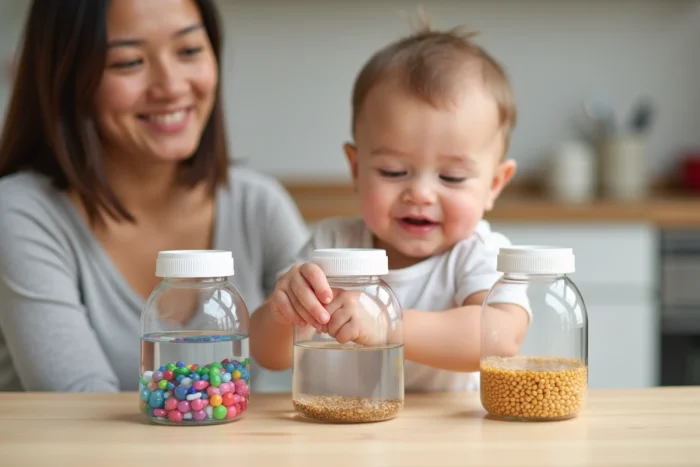
A small transparent plastic bottle, tightly sealed, filled with colored water and a few beads or glitter: the baby shakes it, turns it over, and observes the movement. It’s a calm visual activity, suitable for moments when they are tired.
- Glue the cap with strong adhesive to prevent any accidental opening
- Avoid overly heavy bottles; a small container is sufficient
- Change the contents (colored rice, pom-poms) to renew interest without multiplying objects
10. Mystery bag game with three familiar objects
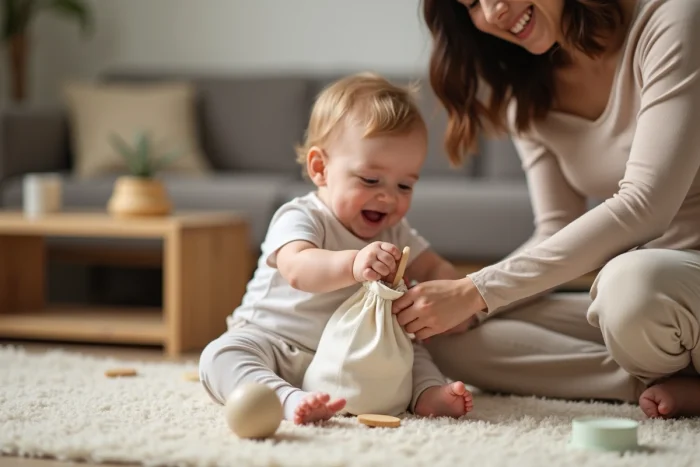
A fabric bag containing three known objects (ball, spoon, small stuffed animal): the baby reaches in, grabs an object without seeing it, and pulls it out. The surprise, tactile recognition, and repetition of appearance-disappearance make it a cognitively rich activity.
Start with a maximum of three objects. Beyond that, the baby loses concentration, and the game becomes confusing. Simplicity is the best ally for awakening at this age: a few well-chosen objects, short sessions, and the opportunity to repeat as often as they wish.